


In 2014 Health Workforce Australia (HWA) released a report on the future oral health workforce. It came amidst claims from the dental profession that we were facing an oversupply of dentists and calls to cap the number of dental schools and domestic dental graduates, as well as removing dentists from the Skilled Occupation List.
The HWA report predicted a persistent workforce oversupply until at least 2025, projecting that we would have 19,624 dentists and dental specialists working clinically in Australia.
In this episode of the Dental As Anything podcast I drill down into the Health Workforce Australia modelling to see whether their workforce predictions were correct [narrator – they were not], and take a more detailed look at the maldistribution of the dentist workforce over the past decade.
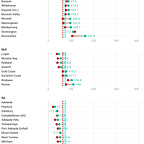
Change in dentists per 100,000 between 2013 and 2024
The following charts show the change in the number of dentists (including dental specialists) per 100,000 people by Local Government Area, broken down into Major Cities, Inner Regional and Outer Regional.
In 2024, 74.6% of the Australia population lived in Major Cities, 16.7% in Inner Regional and 7.1% in Outer Regional areas, with 82.3% of dentists working in Major Cities, 12.3% in Inner Regional and 4.8% in Outer Regional areas.
The charts also show the average number of dentists per 100,000 for each of the respective regions in 2013 and 2024, and shows those where the number of dentists has declined and those who are still below the 2013 average for that region.
Note: Adelaide (820) and Perth data have been excluded because their generally small population and high number of dentists skews the charts.

